Hangzhou Water Bus Route 7 — A Local's Guide
Ride Hangzhou's Route 7 water bus through ancient stone bridges and willow-lined canals. A complete guide to boarding, payment, and why this is the best $0.40 you'll spend in the city.
I've lived in Hangzhou for over 20 years, spent my college time here and raised a family here. Route 7 water bus is not fancy, not fast, and definitely not famous outside Hangzhou — but it's the most charming way to feel the Jiangnan and the peaceful heart of the old city.
Route 7 is a public water bus that runs through downtown Hangzhou. For just 3 RMB (about $0.40), you get a 45-minute boat ride under ancient stone bridges, past weeping willows, tea houses, and neighborhoods that haven't changed much in decades.
One Sunday at 9 am, I brought my son to Plum Blossom Stele. There were already about 20 people in line. The staff told us: '3-hour wait.' We had to give up. That's when I learned — never go on a weekend.
Why This Is a Local's Secret
Hangzhou has four water bus lines. Route 7 is the only one that uses small traditional caofang boats (8 seats only). The only one that winds through the narrow East River, slipping under bridges so low you could almost touch them. And the only one that still feels like old Jiangnan — water towns, stone bridges, and slow life.
These days, thanks to social media, many tourists know about it. But on weekday mornings, you'll see locals heading to work, young couples exploring, and a few photographers capturing the bridges. No tour groups. No loudspeakers. Just Hangzhou from the water.
⚠️ Important: Don't Go on Weekends ⚠️
Because the boat has only 8 seats and runs only once per hour, weekends are very crowded. I've seen people wait 2–3 hours on a Saturday.
Go on a weekday (Tuesday–Thursday is best). Arrive at least one hour before the first boat (7:40 am from Bazi Bridge). That means 6:40 am. Bring mosquito repellent — the river is lovely, but so are the mosquitoes.
If you can only go on a weekend? Consider walking the riverside path instead (see below). It's free and just as beautiful.
Where to Board – And My Personal Advice
The main terminal is Bazi Bridge (坝子桥), near Baoshanqiao Station on Line 5 (Exit B2, then walk about 10 minutes).
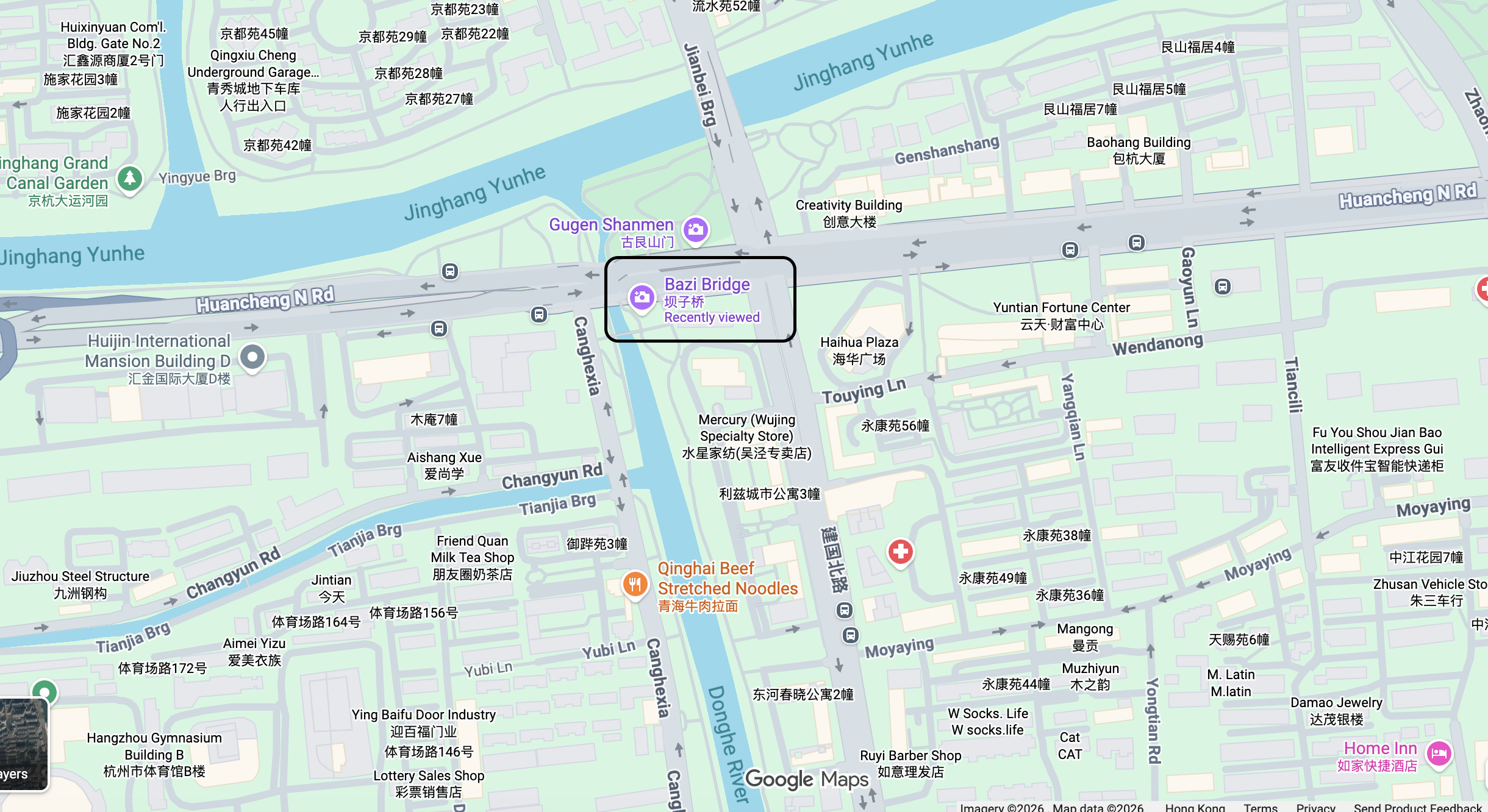
Alternatively, you can start from the southern terminal at Plum Blossom Stele (梅花碑) inside Wuliu Lane — it's often less crowded for boarding.
My personal advice: Start from Bazi Bridge. Take the full ride south to Plum Blossom Stele. Once you get off, you're perfectly positioned to walk to Hefang Street (河坊街), Drum Tower (鼓楼), and Wu Hill (吴山) — all within 10–15 minutes. This way you get the complete boat experience plus easy access to Hangzhou’s historic food and temple area. If you start from the other end, you'll have to backtrack.
How to Pay
- Alipay — Scan the QR code at the dock using Alipay's transport feature. Fastest.
- Cash — Accepted, but the machine doesn't give change and only takes coins (exact 3 RMB).
No booking. Just queue, then pay when you board.
The Bridges: A Moving Museum
The East River was first dug in the Tang Dynasty. In the Southern Song Dynasty, Emperor Gaozong built his retirement palace nearby, and part of the river was filled in — that spot is still called Duan He Tou ("Broken River Head").
The Qing poet Yao Siqin wrote:
"This small slice rivals West Lake — twelve bridges mirrored in moonlight, like a rainbow on the water."
Those twelve bridges are what you'll see on Route 7. Here are the highlights:
- Bazi Bridge — The starting point, known as the "First Bridge of the East River." A three-arch stone bridge with a phoenix pavilion on top.
- Baoshan Bridge — Built in 1737 (Qing Dynasty) by a devout Buddhist. Beneath it was once a silk boat wharf — a reminder of Hangzhou's silk trade.
- Guang'an New Bridge — A beautiful single-arch stone bridge. Dragon boat races were once held here.
- Taiping Bridge ("Peace Bridge") — The only covered bridge on the East River. It has a wooden gallery with benches where locals sit and watch the boats pass.
- Caishi Bridge ("Vegetable Market Bridge") — In the old days, vegetable boats moored here to sell goods. A working-class memory.
- Dofu Bridges (1st, 2nd, 3rd) — Their name means "Struggle to Be Rich." A famous local legend about rival wealthy families.
- Anle Bridge — "Peace and Joy." Said to be built by a Song Dynasty general.
- Zhangjia Bridge — One of the oldest, named after the Zhang family who lived nearby.
Altogether, you'll drift under about 14 to 15 bridges, each with its own story.
What to Do After You Disembark
The boat ends at Plum Blossom Stele, right inside Wuliu Lane. Don't leave immediately — explore:
- Wuliu Lane Historic District — Wander the alleys. Stop for tea or coffee at a small, independent shop.
- De Shou Gong (Emperor Gaozong's Retirement Palace) — Just a 5-minute walk. Free admission (reservation required). Stunning Song Dynasty architecture and iconic red walls — great for photos.
- Hu Xueyan's Former Residence — A hidden "luxury mansion of Jiangnan." Quiet, uncrowded, and beautiful.
- Hefang Street / Southern Song Imperial Street — About a 15-minute walk. Lively pedestrian street with street food, shops, and classical architecture.
A great local walking route after the boat:
Wuliu Lane → De Shou Gong → Hu Xueyan's Mansion → Drum Tower → Hefang Street.
Final Local Tips
| Tip | Why |
|---|---|
| Weekdays only | Weekends = 2–3 hour waits. Go Tuesday–Thursday. |
| Arrive before 7 am | First boat at 7:40. Be there by 6:40 to get a seat. |
| Bring mosquito repellent | The river has mosquitoes, especially in summer. |
| Start from Plum Blossom Stele | Fewer people board there. |
| Can't get on? Walk the path | The riverside path is free, no queue, and you'll see the same bridges and views. |